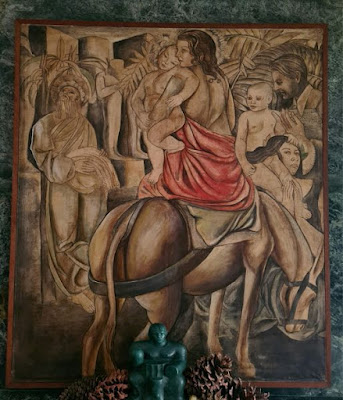
Federico Cantú Mural Capilla de los Misioneros de Guadalupe 1957-58 Tlalpan Pintura al fresco Crucifixión y Dios Padre Cristo llevando la cruz es un episodio evangélico y tema artístico muy frecuente en la devoción y el arte cristiano, denominado también de muchas otras formas (Jesús o Cristo portando la cruz o su cruz -con mayúsculas en la mayor parte de la bibliografía-, cargando la cruz, con la cruz a cuestas o al hombro, etc.) Es parte del ciclo de la Pasión de Cristo y del Via Crucis, y contiene muchos episodios que pueden ser objeto de tratamiento artístico por separado o bien representarse conjuntamente (el Cirineo, la Verónica, las caídas, etc.)El Calvario, también conocido como el Gólgota, fue un sitio que se encontraba cerca del exterior de las murallas de Jerusalén. En este lugar, según los Evangelios, fue crucificado Jesús de Nazaret. El término «Gólgota» o «Gólgotha» proviene del griego Γολγοθᾶ, posteriormente escrito como Γολγοθᾶς, que es la transliteración g...
Madonna and Child was painted by one of the most influential artists of the late 13th and early 14th century, Duccio di Buoninsegna. This iconic image of the Madonna and Child, seen throughout the history of western art, holds significant value in terms of stylistic innovations of religious subject matter that would continue to evolve for centuries. The Madonna and Child is understood to be an intimate, devotional image. Some evocations of this understanding come from the burnt edges on the bottom of the original engaged frame caused by burning candles that likely would have sat just beneath Looking past the abrupt simplicity of the image, one can begin to understand the changes Duccio was applying to the depiction of religious figures in painting during the early 14th century. Duccio followed other innovative Italian artists of the time like Giotto, both of whom strove to move beyond the purely iconic Byzantine and Italo-Byzantine canon and attempted to create a more tangible c...
Federico Cantú 1907-1989 La Letanía Lauretana Obra por encargo ejecutada para La Iglesia de la Purísima De Monterrey Nuevo León Portada de la Letanía Lauretana Buril en plata Exposición 2018 Salón de la Plástica Mexicana Lista de obra Grabado al buril y punta seca. 1946-1948 19 grabados sobre dibujos de Federico Cantu el autor burilo Todas las tintas y anteproyectos asi como el concepto Grafico fue de Federico Cantú La purísima se convertiría en el cuarto recinto sacro intervenido por el Artista Federico narra en sus memorias que cundo muy joven en una breve y fructífera etapa deja el atelier de Paris para instalarse en Los Ángeles California donde inicia su carrera monumental en el arte sacro, despues de una solicitud promovida por un párroco de Pasadena , donde pinta una serie de obras que incluirían la tramadle Cristo negro asi como una serie de Madonas para el presbiterio de la Iglesia de Pasadena California en 1928 , ...


Comentarios
Publicar un comentario